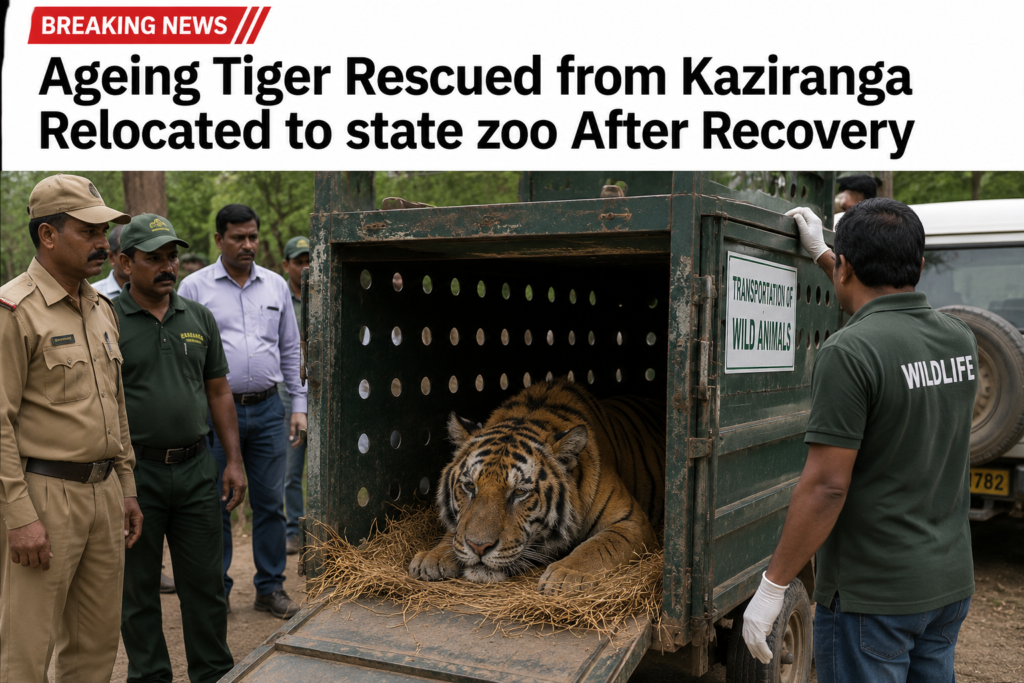
Kaziranga, June 30: An ageing Royal Bengal tiger that had been receiving treatment at the Centre for Wildlife Rehabilitation and Conservation (CWRC) in Kaziranga after being rescued earlier this month has now been relocated to the Assam State Zoo-cum-Botanical Garden in Guwahati for long-term care and management.
The tiger had created concern in villages surrounding the Agaratoli Range of Kaziranga National Park and Tiger Reserve before it was captured by forest officials after repeatedly preying on livestock in nearby fringe villages.
“The tiger was captured on June 8 and, following a detailed health assessment, it was found to have multiple injuries and was in a weak physical condition. We therefore shifted it to our rehabilitation centre for treatment. It has now recovered sufficiently and is fit to be transported to the zoo,” said Arun Vignesh, Divisional Forest Officer (DFO) of the Eastern Assam Wildlife Division.
Forest department officials stated that the tiger had been responsible for killing several cattle in villages near the eastern range of the national park. Reports suggested that, on certain occasions, it had killed as many as seven to eight cattle in a single day.
These repeated livestock attacks had increased anxiety among local residents, prompting the Forest Department to keep the animal under close surveillance before successfully capturing it.
After the rescue operation, the tiger was taken to the CWRC at Borjuri in Kaziranga, where veterinary teams treated injuries to its legs, claws, and canine teeth.
Vignesh explained that the tiger’s advanced age and declining physical health were the key reasons it had begun entering human-dominated areas in search of food.
“The tiger had increasingly depended on livestock because it was no longer able to hunt wild prey effectively,” he said.
Veterinary specialists involved in the treatment confirmed that age-related health deterioration had greatly reduced the tiger’s ability to survive in its natural habitat.
“This was a rescued tiger that had sustained multiple injuries. Medical examinations also confirmed that the animal is ageing and has lost its canine teeth. At the Assam State Zoo, it will continue receiving medical treatment, proper nutrition, and long-term care,” a veterinarian associated with the rehabilitation programme said.
Officials added that the transfer was carried out in full compliance with the guidelines issued by the National Tiger Conservation Authority (NTCA).
“As per the NTCA guidelines, the Royal Bengal tiger has been shifted to the Assam State Zoo to ensure its continued care and overall well-being,” Vignesh said.
The ageing tiger will now remain under the supervision of veterinary experts at the Assam State Zoo-cum-Botanical Garden, where its health will be monitored regularly while it receives specialised treatment, proper feeding, and lifelong care.