Introduction
There are only a few places on earth where you can watch a one horned rhino graze peacefully across open grassland while a Royal Bengal tiger silently slips through the tall grass nearby. Kaziranga National Park in Assam is one of those rare spots, and honestly it’s almost unreal. What makes it even more astonishing is not just the view, but how close this place actually came to losing everything, and how one chance visit more than a hundred years ago kind of changed the whole fate of it, for good.
The history of Kaziranga National Park is not just a story about wildlife. It is a story about how humans realized their mistakes in time, fought to correct them, and turned a nearly destroyed forest into one of the greatest conservation success stories in the world.
Where It All Began
Long before Kaziranga had any official name or boundary, it was a dense floodplain forest sitting between the mighty Brahmaputra River and the Karbi Anglong Hills in northeastern Assam. Local communities called this region home for centuries. Historical records mention the name “Kaziranga” as far back as the 17th century. The name itself comes from Karbi language roots — some legends connect it to the word for red goat, while others link it to a local woman named Karbi who once ruled this land.
In the 18th and 19th centuries, when the tea business really took off in Assam, big stretches of forest were cleared for tea gardens and people’s settlements. The one horned rhinoceros, it had been doing fine on those grasslands for thousands of years, but then it just started to vanish, kind of fast. Poaching kept running wild, not just a little. The animal was being hunted for its horn, and that horn was said to have a medicinal value, at least that is what folks believed. By the early 1900s, its numbers were already down to dangerously low levels , almost like there was barely enough left.
The Visit That Changed Everything (1904)
In 1904, an American woman named Mary Victoria Leiter Curzon — the wife of Lord Curzon, the Viceroy of India — visited the forests of Kaziranga. She had heard about the famous one-horned rhinoceros that lived here. But during her entire visit, she could not spot a single rhino. Not one.
That absence shook her deeply. She came back and urged her husband, Lord Curzon, to take immediate action to protect what little was left. Lord Curzon listened. On November 4, 1904, he formally proposed creating a wildlife reserve in Kaziranga. This one conversation between a concerned woman and a colonial official is what started the chain of events that eventually gave Kaziranga its protection.
From Reserve Forest to National Park: The Timeline
1905: On June 1, the Kaziranga Proposed Reserve Forest was officially created, covering around 232 square kilometres.
1908: The area was upgraded to a full Reserve Forest under British colonial administration, giving it legal protection and banning unauthorized entry.
1916: Kaziranga was declared a Game Sanctuary, which offered stronger protection for wildlife, especially rhinos.
1938: The forest was opened to the general public for the first time, allowing visitors to see the wildlife that had slowly started recovering.
1950: After Indian independence, Kaziranga was declared a Wildlife Sanctuary, placing it under Indian conservation laws.
1954: The Assam Legislative Assembly passed the Assam Rhinoceros Bill, making it illegal to hunt or harm a one-horned rhinoceros. Violators faced heavy penalties.
1968: The Assam National Park Act was passed specifically because there was no existing law to formally create a national park in the state.
1974: On February 11, Kaziranga was officially declared a National Park — the first national park in the state of Assam — covering 429.93 square kilometres.
1985: UNESCO inscribed Kaziranga as a World Heritage Site, recognizing it as one of the last undisturbed natural areas in northeastern India and a critical habitat for the greater one-horned rhinoceros.
2006: Kaziranga was designated a Tiger Reserve under Project Tiger, adding another layer of legal protection for the Royal Bengal tiger population.
Why Kaziranga’s Conservation Is a Big Deal
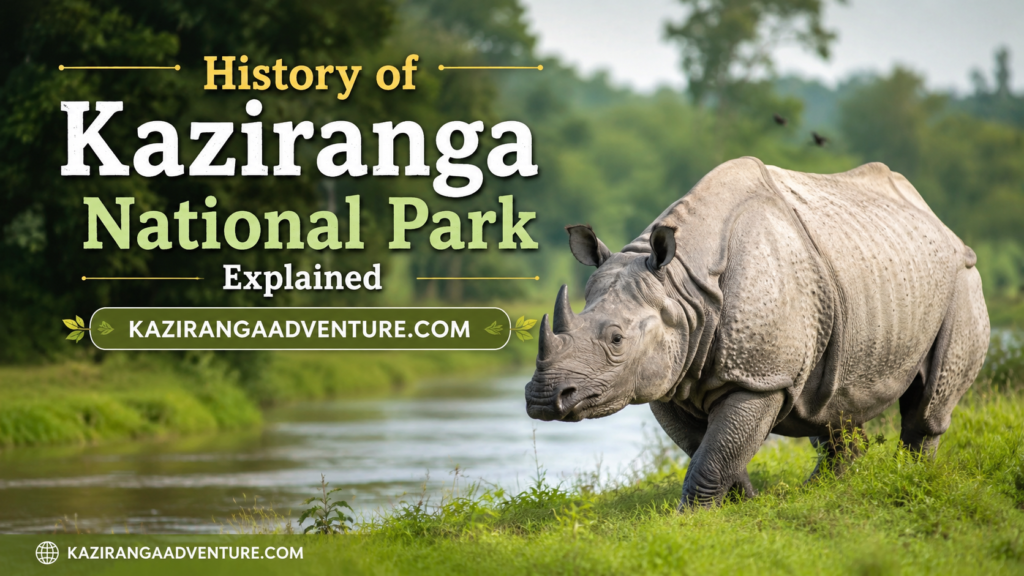
When protection began in 1905, the rhino population was on the edge of extinction. By the time Kaziranga became a national park in 1974, numbers had slowly started climbing. Today, Kaziranga is home to around 2,613 one-horned rhinoceroses — roughly two-thirds of the entire world’s population of this species. That is an extraordinary recovery.
The park also shelters over 100 Royal Bengal tigers, more than 1,100 Asian elephants, wild water buffaloes, swamp deer and over 480 species of birds. It was recognized as an Important Bird Area by BirdLife International, but in a more general way too. The Brahmaputra River, which floods the park every monsoon, is really what keeps this ecosystem alive—those floodwaters, renew the grasslands and help sustain the wetlands that the wildlife depends on.
Kaziranga National Park is often called the Big Five destination of India — rhino, tiger, elephant, wild water buffalo, and swamp deer can all be spotted in a single gypsy safari.
Exploring Kaziranga Today
The park is divided into four main safari zones:
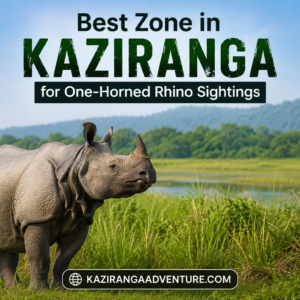
The Central Range (Kohora Zone) is the most popular. It offers the best chances of spotting rhinos, elephants, and tigers, and is the entry point for both gypsy safari and elephant safari.
The Western Range (Bagori Zone) has the highest density of rhinos and is a favourite for wildlife photographers.
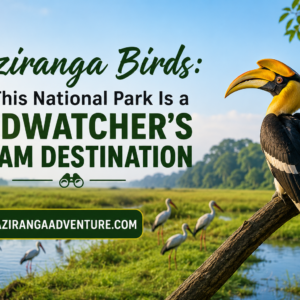
The Eastern Range (Agaratoli Zone) is ideal for birdwatching, with wetlands and water bodies attracting hundreds of bird species.
The Burapahar Zone is set in hilly, forested terrain and is the best place to spot the hoolock gibbon — the only ape species found in India.
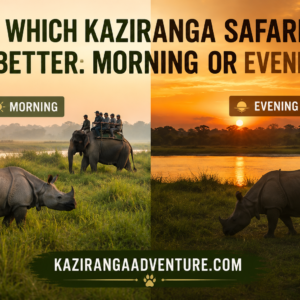
Gypsy safaris and elephant safaris are basically the main ways to explore Kaziranga, and honestly, both are worth it in their own kind of way. Elephant safari in Kaziranga is a particularly unique experience because when you’re riding atop an elephant you get much closer to the rhinos without startling them too much. Morning safaris seem to give the best wildlife sightings, more often than not.
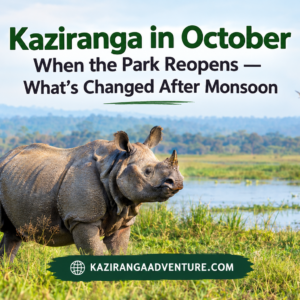
The best time to visit the Kaziranga National Park is between November and April. The park stays closed from June to October , mostly because of flooding linked to the Brahmaputra River.
Beyond the Safari
The experience of visiting Kaziranga is not just about wildlife . The park sits surrounded by some of Assam’s most famous tea gardens , and honestly a guided walk through a tea estate after your morning safari feels like a great way to pass the afternoon. If you head toward Kohora, the Kaziranga Orchid and Biodiversity Park shows off more than 500 orchid species, it’s pretty impressive even for people who usually don’t care about plants. And then, not too far away, the old Deoparbat ruins add another layer , giving you a look into Assam’s story that goes back to the 9th century .
If you want to plan a smooth trip — from safari booking to hotel stays and tour packages — platforms like Kaziranga Adventure offer everything in one place, from gypsy safari booking to accommodation near the park gates.
FAQs
A: Kaziranga was officially declared a National Park on February 11, 1974.
A: It began in 1904 when Mary Curzon, wife of the Viceroy Lord Curzon, urged her husband to protect the rhinos she failed to spot during her visit.
A: In 1985, UNESCO inscribed Kaziranga as a World Heritage Site.
A: Approximately 2,613 one-horned rhinoceroses — nearly two-thirds of the world’s total population.
A: Yes. Kaziranga was designated a Tiger Reserve under Project Tiger in 2006.
A: November to April is the best time. The park closes from June to October due to monsoon flooding.
A: Kaziranga has four zones — Central (Kohora), Western (Bagori), Eastern (Agaratoli), and Burapahar.
A: It is world-famous for being home to the largest population of the Indian one-horned rhinoceros, and for being a UNESCO World Heritage Site with extraordinary biodiversity.
A: Around 204 kilometres by road. It takes approximately 3 to 4 hours by car.
Conclusion
The history of Kaziranga National Park is, honestly, one of the most inspiring conservation stories you will run across. What began in 1904 with a small and heartbreaking note made by a visitor, sort of quietly, turned into a century-long push involving forest officials, lawmakers, wildlife activists, and the local Assamese community. And now the park is there, standing as proof that if protection comes at the right time, nature can bounce back with this almost unbelievable power.
If you are planning to visit Kaziranga, you are not just going for a safari. You are stepping into a living piece of history where every rhino you see is a reminder of how close the world came to losing this species and how determined people made sure that did not happen.
Book your Kaziranga safari early, choose the right zone for your interests, and give yourself at least two full days to take it all in properly.