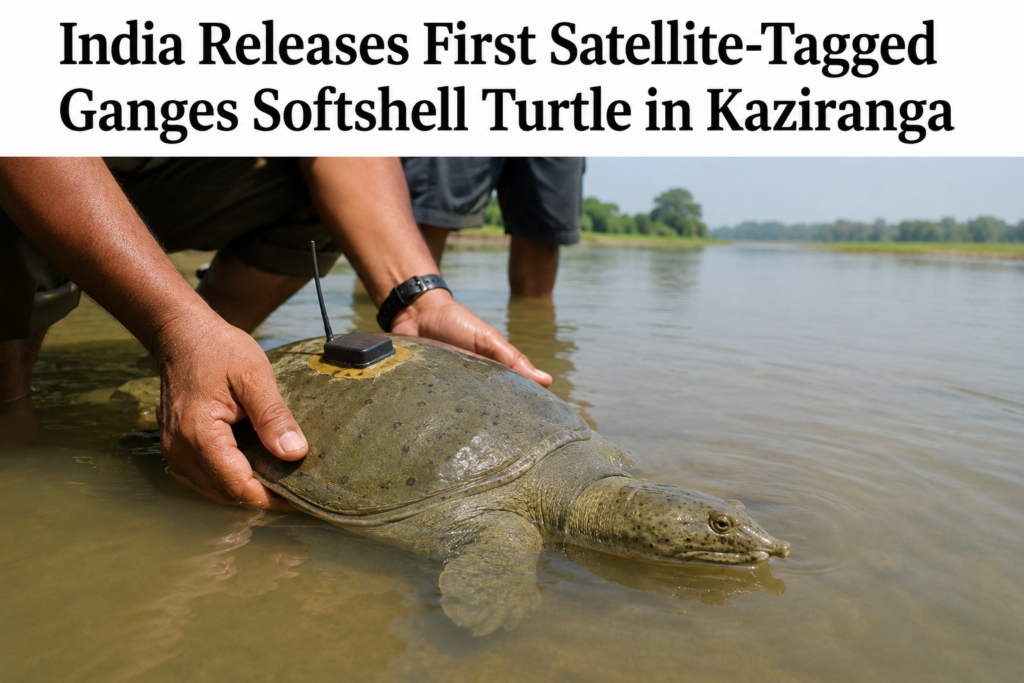
Assam marked a major milestone in wildlife conservation as India’s first satellite-tagged Ganges softshell turtle was released in Kaziranga National Park on Friday, coinciding with Endangered Species Day. The initiative is being seen as an important step towards strengthening conservation efforts for endangered aquatic species in the state.
Chief Minister Himanta Biswa Sarma described the event as a proud moment for Assam. Sharing the update on social media, he stated that the satellite tagging project reflects the state’s continued commitment to protecting every species that inhabits Assam’s forests and wetlands.
The development comes at a time when Assam has been witnessing several encouraging conservation successes. Wildlife experts recently reported the rare sighting of a critically endangered gharial in the Burapahar Range of Kaziranga National Park. Forest staff first spotted the reptile on April 26, followed by another sighting by a tourist guide on May 8. The sightings have renewed hopes for the return of the species to Assam’s river systems, where it was once believed to have disappeared.
Another significant achievement was recorded at Hollongapar Gibbon Sanctuary, where an endangered Hoolock Gibbon was seen successfully using an artificial canopy bridge installed over railway tracks. According to the Wildlife Institute of India, this is the first confirmed and documented use of such a bridge by India’s only ape species. The bridge was constructed by the Northeast Frontier Railway to reduce threats posed by railway electrification and train movement through the sanctuary.
Wildlife researchers have called these developments encouraging signs for conservation in Assam, while also emphasizing the need for long-term ecological planning. Experts believe that infrastructure projects passing through sensitive habitats should undergo strict scientific scrutiny, with strong monitoring mechanisms to ensure mitigation measures are properly implemented.
Conservationists have also highlighted the growing concern of human-wildlife conflict across Assam, particularly involving elephants and leopards. Increasing encroachment into forest areas and wildlife corridors has intensified interactions between humans and wild animals, making habitat protection and community participation critical for long-term conservation success.
Officials and wildlife experts stress that conservation cannot remain limited to forest departments and researchers alone. Greater public awareness, stronger participation from communities living near forests, and sustained government support are considered essential to protecting endangered species and preserving Assam’s rich biodiversity.
Earlier this year, Chief Minister Himanta Biswa Sarma also inaugurated the Kaziranga Orchid Park at Kohora inside Kaziranga. Developed across nearly 20 bighas at an estimated cost of Rs 16 crore, the park houses more than 900 species of indigenous and exotic orchids. The facility includes advanced glasshouses, a children’s garden, a 500-seat amphitheatre, tourist accommodation, traditional cuisine facilities, and other visitor amenities aimed at promoting conservation, tourism, and environmental education together.