Rare Migratory Bird Spotted During Annual Waterbird Census
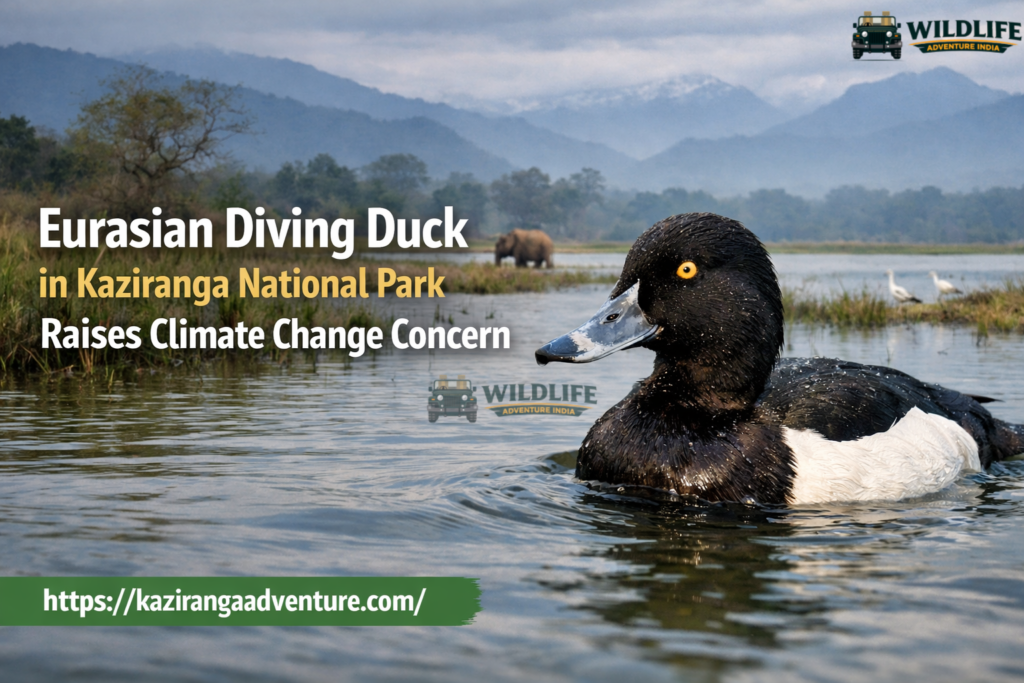
The seventh Kaziranga National Park waterbird census report has recorded something very special this year—a Eurasian diving duck spotted in Kaziranga National Park for the first time. The report, released on February 25, 2026, confirmed the presence of a rare duck known as the Smew. This species usually breeds in the cold Eurasian taiga region of northern Europe and Asia, far away from India.
The Smew bird sighting in Assam in 2026 is important because the species is not commonly seen in this part of South Asia. Normally, the smew migrates within Europe and parts of northern Asia. Its unexpected appearance in Assam has surprised birdwatchers, wildlife photographers, forest officials, and researchers. Many scientists believe that this unusual movement may be linked to the growing climate change impact on migratory birds in India and across the world.
Climate change affects global weather systems. It changes temperature patterns, rainfall cycles, snowfall levels, wind directions, and seasonal timing. When these natural systems shift, birds may not find suitable food, water, or safe breeding conditions in their traditional habitats. As a result, they may change their long-established migration routes. That is why sightings of rare migratory birds in Northeast India’s wetlands are now being closely studied by experts.
This rare observation is not just an exciting record for bird lovers. It may also be an early environmental signal.
Understanding the Smew and Its Natural Habitat
The smew is a small, striking diving duck with bright white plumage and bold black markings, which are most prominent in adult males. These birds journey across thousands of kilometres to seek warmer climates during severe winters. It is known for living in cold freshwater lakes and forested wetlands in the Eurasian taiga belt. During breeding season, it prefers tree-lined lakes in remote northern regions.
In winter, Smews usually migrate to slightly warmer regions of Europe and parts of East Asia. They are rarely recorded in India. Because of this, the Eurasian taiga breeding duck appearing in India has raised important scientific questions.
Bird migration is not random. It follows seasonal patterns developed over thousands of years. When a species appears outside its normal range, scientists look at possible causes such as habitat destruction, food shortage, extreme weather events, or climate shifts.
Large-Scale Kaziranga Wetlands Biodiversity Survey
The Assam waterbird count 2026 highlights show that the survey was conducted from January 4 to January 11 across 166 wetlands in 10 forest ranges of the park. This detailed Kaziranga wetlands biodiversity survey involved forest guards, senior officers, ornithologists, environmental researchers, students, and trained volunteers.
Teams started early in the morning and worked until late evening. Early morning and sunset hours are the best times to observe waterbirds. Survey members used binoculars, cameras, GPS tools, and standardised counting methods to record accurate numbers.
The main goals of the survey were:
- Counting the total bird population
- Identifying species diversity
- Monitoring wetland health
- Recording rare or threatened species
- Studying changes compared to previous years
This annual exercise plays a very important role in strengthening wetland conservation and migratory bird protection programmes in Assam.
Long-term surveys like this help scientists compare data year after year. Without such data, it would be impossible to understand whether climate change effects on bird migration routes are temporary or long-term.
Kaziranga National Park as a Key Migratory Bird Habitat
Kaziranga is globally famous for its one-horned rhinoceros and tiger population. However, it is also one of the most important Kaziranga National Park migratory bird habitats in Northeast India.
Every winter, thousands of birds arrive from Central Asia, Siberia, Mongolia, China, and Europe. These birds migrate thousands of kilometres to avoid harsh winter conditions and freezing temperatures. Kaziranga’s wetlands offer shallow water, a rich fish supply, aquatic plants, and safe resting grounds.
During the 2026 census, the most commonly sighted birds included:
- Bar-headed Goose
- Northern Pintail
- Lesser Whistling Duck
These species return every year. Their regular arrival helps experts monitor environmental stability. If their arrival timing changes or their population decreases, it may signal an ecological imbalance.
This clearly shows the importance of wetlands in climate monitoring. Wetlands act like natural climate recorders. Changes in bird patterns reflect larger environmental changes happening far away.
Why Climate Change Affects Bird Migration
Bird migration depends on several natural factors:
- Seasonal temperature changes
- Length of daylight
- Availability of food
- Water levels in wetlands
- Safe breeding grounds
If winters become warmer or breeding areas face deforestation, forest fires, or melting snow, birds may struggle to survive. In such situations, they may explore new locations.
The growing climate change impact on migratory birds in India is becoming more visible. Experts have noticed shifts in migration timing, unusual early arrivals, delayed departures, and rare species appearing in unexpected regions.
The Smew sighting may be part of this larger pattern. Although one record cannot confirm a permanent migration change, it highlights the need for continued monitoring.
Threatened Species Add to Conservation Importance
The survey also recorded several IUCN Red List threatened bird species in Kaziranga. One species was listed as critically endangered and another as endangered.
This makes Kaziranga even more important at a global level. Protecting such habitats ensures the survival of vulnerable bird species.
Wetlands are not just bird homes. They:
- Reduce flood damage
- Recharge groundwater
- Filter pollutants
- Store carbon
- Support fish and plant life
Strong wetland conservation and migratory bird protection strategies are necessary to protect biodiversity.
Rowmari Beel Bird Population Record
Among all wetlands surveyed, Rowmari Beel recorded the highest bird population. Donduwa Beel and Sohola wetlands also showed impressive bird numbers.
Large wetlands support bigger bird flocks because they offer more feeding space. Smaller wetlands, however, showed greater species diversity. Both population size and diversity are important indicators of ecosystem health.
The Rowmari Beel bird population record provides useful data for habitat planning and future conservation steps.
Community Participation and Awareness
The success of the waterbird census is also due to local participation. Students, nature clubs, and volunteers actively took part. Their involvement spreads awareness about the effects of climate change on bird migration routes and the importance of environmental protection.
Community involvement helps build a long-term conservation culture. When local people understand the value of wetlands, they are more likely to support protection measures.
Northeast India Bird Census Conservation Success
Since its beginning in 2018–19, the survey has grown into a Northeast India bird census conservation success story. With improved methods and wider coverage, the data quality has become stronger every year.
CSR support from Numaligarh Refinery Limited has helped improve equipment, training, and documentation. Continuous scientific monitoring allows experts to detect long-term trends.
This growing database is essential for studying the climate change impact on migratory birds in India.
Wetlands as Environmental Warning Systems
Wetlands are natural environmental indicators. When bird populations increase, it shows healthy ecosystems. When rare species appear or common species decline, it may signal stress.
The Eurasian diving duck spotted in Kaziranga National Park may be one such early warning sign. Climate change does not always create sudden disasters. Sometimes it slowly alters migration patterns, water cycles, and food chains.
Birds are often the first indicators of environmental imbalance.
Global Significance of the Sighting
The Smew sighting has attracted attention from birdwatchers across India and abroad. It highlights how connected global ecosystems are. Changes in the Arctic or European taiga can affect bird movements in Assam.
This shows that climate change is not limited to one country. It is a shared global challenge.
Conclusion: Nature’s Silent Message
The 2026 waterbird census results bring both hope and concern. High bird numbers reflect successful conservation. At the same time, the rare Smew bird sighting in Assam in 2026 highlights possible climate-related shifts.
To protect this important Kaziranga National Park migratory bird habitat, continued action is necessary:
- Strengthen wetland conservation programmes
- Expand biodiversity monitoring
- Promote climate education
- Support scientific research
- Encourage community participation
Kaziranga’s wetlands are a natural treasure for India and the world. The arrival of a Eurasian diving duck reminds us that environmental changes are already happening.
In simple words, when birds change their routes, nature is sending us a message. It is our responsibility to listen and act wisely.