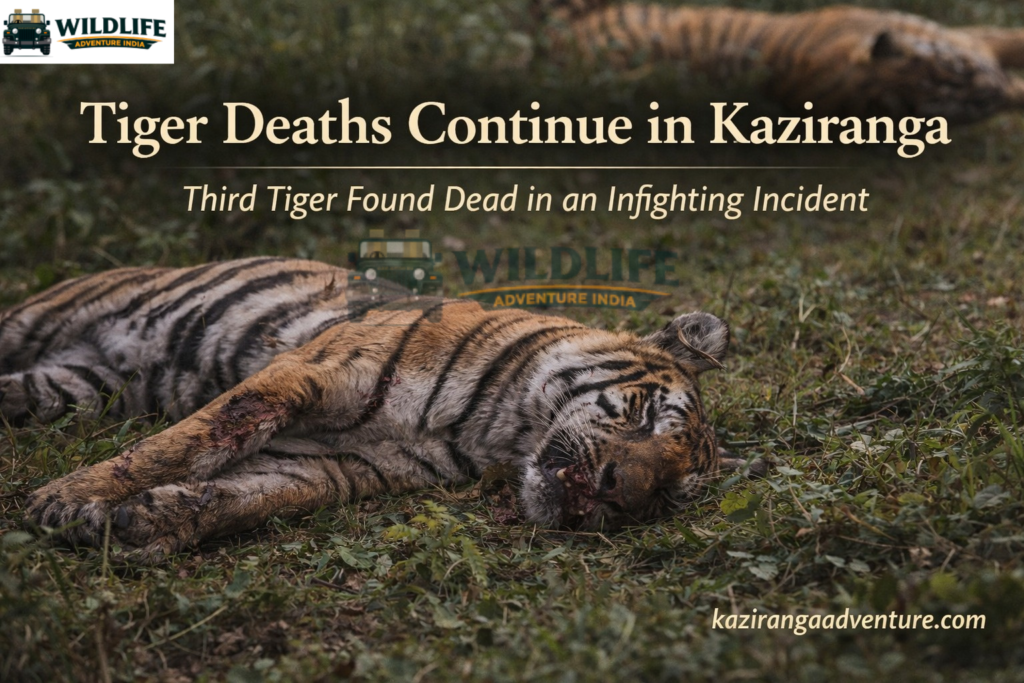
Tiger deaths continue in Kaziranga National Park, raising serious alarm among wildlife experts, conservationists, and forest authorities. The recent discovery of the third tiger found dead in Kaziranga forest within a short time span has intensified concerns about rising territorial stress, habitat saturation, and the long-term sustainability of one of India’s most successful tiger conservation landscapes.
Kaziranga National Park and Tiger Reserve (KNPTR), located in Assam, is a UNESCO World Heritage Site and one of India’s most iconic wildlife destinations. Internationally celebrated for its population of one-horned rhinoceroses and its dense tiger population, Kaziranga has long been considered a conservation success story. However, the recent spate of tiger deaths has triggered widespread discussion about the causes of tiger deaths in Kaziranga, even inside a strictly protected reserve.
Wildlife enthusiasts, researchers, and tourists often depend on trusted platforms such as Kaziranga Adventure for safari updates, travel planning, and conservation awareness. Yet, despite strong protection measures, the increasing frequency of tiger deaths has highlighted emerging ecological challenges that demand urgent attention.
Third Tiger Found Dead in Kaziranga Forest
On Sunday afternoon, forest officials recovered the carcass of a female Royal Bengal tiger from the Kathpora area of the Bagori range inside Kaziranga National Park. The discovery was made during routine patrolling by forest personnel, who immediately alerted senior officials after confirming the identity of the animal.
A special investigation committee was constituted to examine the incident. A detailed post-mortem examination revealed multiple deep injuries across the tiger’s body. According to forest officials and veterinary experts, the pattern and severity of wounds clearly indicated violent territorial infighting with another tiger.
Authorities confirmed that there were no signs of poaching, poisoning, snaring, or human interference. The entire process—from carcass recovery to post-mortem—was conducted strictly in accordance with the Standard Operating Procedures (SOPs) laid down by the National Tiger Conservation Authority (NTCA).
This tragic incident officially marks the third tiger found dead in Kaziranga forest due to infighting within the past five months, reinforcing fears that such conflicts are becoming increasingly frequent. Similar concerns were earlier highlighted in reports published on the Kaziranga Adventure Blog, indicating a worrying pattern inside the reserve.
Why Tiger Deaths Continue in Kaziranga National Park
Tigers are solitary and highly territorial carnivores. Unlike lions, they do not live in prides or social groups. Each tiger requires a large territory to hunt prey, rest, and breed successfully. These territories are fiercely defended, particularly by adult males.
Infighting among tigers generally occurs when:
- Young male tigers attempt to establish new territories.
- Adult males compete for dominance and access to females.
- Territory boundaries overlap due to limited space
In reserves with high tiger density, territorial disputes become more intense and frequent. While occasional fights are a natural part of tiger behaviour, repeated fatalities within a short period signal increasing ecological pressure. This explains why tiger deaths continue in Kaziranga National Park, despite strong protection and effective anti-poaching enforcement.
Kaziranga’s High Tiger Density and Limited Space
Recent official estimates suggest that Kaziranga is home to approximately 148 Royal Bengal tigers, making it one of the highest tiger-density regions anywhere in the world. This remarkable figure reflects decades of dedicated conservation efforts, robust law enforcement, and healthy prey populations.
However, conservation success also brings new challenges. As tiger numbers increase within a fixed geographic area, competition for space intensifies. Kaziranga’s landscape further compounds the problem. The park is surrounded by rivers, national highways, agricultural land, villages, and human settlements, all of which restrict tiger movement beyond park boundaries.
These geographical and human-made barriers significantly limit natural dispersal routes. As a result, young tigers are often unable to migrate to new forests, forcing them into conflict with resident adults. This lack of dispersal space plays a major role in the causes of tiger deaths in Kaziranga, particularly those resulting from violent territorial clashes.
A Disturbing Pattern of Tiger Deaths
The latest incident is not an isolated event. Over the past few weeks and months, Kaziranga has witnessed a troubling pattern of tiger fatalities linked primarily to infighting.
- Early January 2026: A female Royal Bengal tiger was found dead in the Bagori range. Initial investigations pointed to territorial conflict.
- Mid-January 2026: A young male tiger was discovered dead in the Thute Chapori area of the Eastern Range. Post-mortem findings confirmed injuries caused by a fight with another tiger.
- Late January 2026: Another female tiger was found dead, with forensic analysis again suggesting fatal infighting.
This series of events confirms that tiger deaths continue in Kaziranga National Park, attracting the attention of wildlife scientists, conservation organisations, and government authorities at both state and national levels.
Causes of Tiger Deaths in Kaziranga
Experts studying these incidents have identified several major causes of tiger deaths in Kaziranga, particularly those linked to infighting:
1. Habitat Saturation
Kaziranga has a limited geographical area. As tiger numbers rise, young and subadult tigers struggle to find vacant territories, leading to aggressive encounters.
2. Loss of Wildlife Corridors
Wildlife corridors connecting Kaziranga to nearby forest landscapes have been reduced or degraded due to infrastructure development, farming, and settlements, restricting tiger movement.
3. Environmental Stress
Seasonal flooding, increasing tourist activity, and surrounding human pressure contribute to stress, making tigers more aggressive and prone to conflict.
4. High Population Density
High tiger density without corresponding expansion of habitat creates intense competition for space, prey, and mates.
Conservation experts emphasise the importance of advanced scientific monitoring tools such as camera traps, radio collars, and long-term behavioural studies to identify conflict zones before fatalities occur.
Conservation Success Comes with New Challenges
Kaziranga is often cited as one of India’s greatest wildlife conservation achievements. Once threatened by rampant poaching, the park is now a global symbol of successful protection for both rhinos and tigers.
Responsible tourism, supported by official Kaziranga safari booking services, plays an important role in generating awareness and funding for conservation. However, incidents like Tiger Deaths Continue in Kaziranga: Third Tiger Found Dead in an Infighting Incident underline the reality that conservation strategies must evolve with changing ecological conditions.
Similar challenges have been observed in other high-density tiger reserves across India, demonstrating that future conservation efforts must extend beyond protected area boundaries and focus on landscape-level planning.
The Way Forward
To reduce future tiger fatalities and ensure long-term conservation success, wildlife experts recommend several key measures:
- Restoring and protecting wildlife corridors to enable safe tiger dispersal
- Expanding and strengthening buffer zones around Kaziranga
- Enhancing scientific monitoring and data-driven management
- Actively involving local communities in conservation initiatives
- Reducing human disturbance in ecologically sensitive areas
These measures aim to relieve pressure within the park while maintaining healthy tiger populations.
Conclusion
As tiger deaths continue in Kaziranga National Park, the situation serves as a critical reminder that conservation success brings complex challenges. While tiger infighting is a natural phenomenon, repeated deaths within a short time frame highlight deeper issues related to space constraints, habitat connectivity, and population management.
Protecting Kaziranga’s tigers will require a balanced approach that combines strict protection, scientific planning, habitat expansion, and community participation. With thoughtful long-term strategies, Kaziranga can continue to remain a thriving and secure home for tigers for generations to come.