
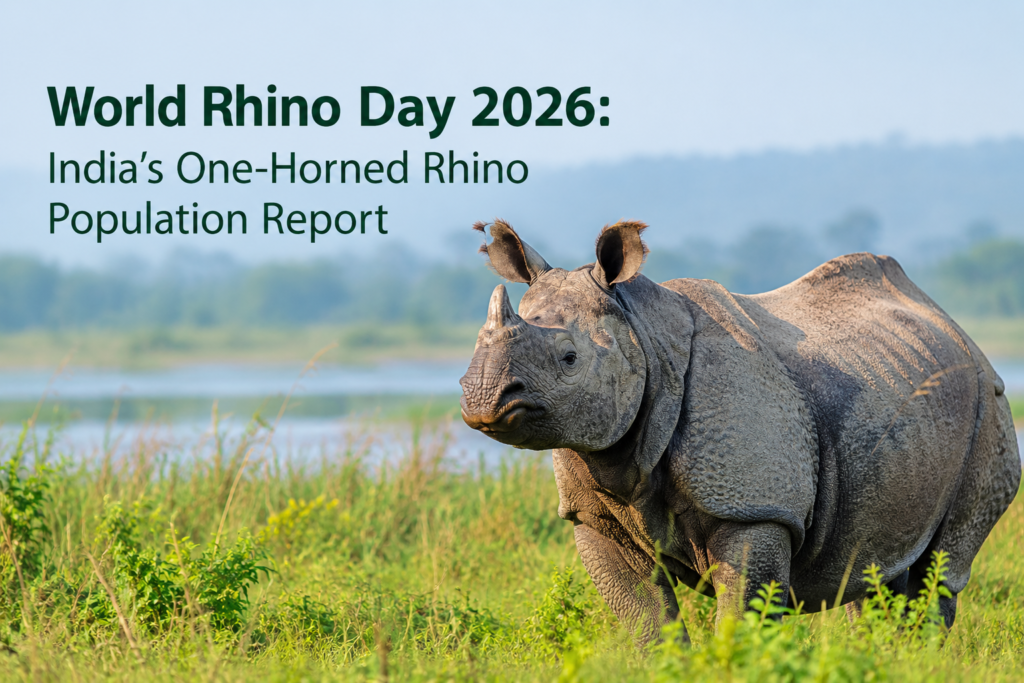
World Rhino Day is observed every year on September 22 to spread awareness about the conservation of the world’s five rhino species. In 2026, the occasion highlights India’s continuing conservation efforts for the greater one-horned rhinoceros, also known as the Indian rhino.
India is one of the main strongholds of the greater one-horned rhino. The International Rhino Foundation’s latest figures estimate 4,075 greater one-horned rhinos across India and Nepal, with 3,323 recorded in India in the latest consolidated estimate.
However, newer state-level surveys have since provided updated figures. Assam’s latest survey reported 3,260 rhinos, West Bengal’s 2025 census recorded 392, and Uttar Pradesh’s 2026 Dudhwa census counted 53. These counts were conducted at different times and through separate exercises, so they should not be treated as one simultaneous national census.
India’s Rhino Population: Latest Numbers
In India, the greater one-horned rhinoceros is mainly found in Assam, West Bengal and Uttar Pradesh. Its habitats are largely associated with river floodplains, wetlands and grasslands of the Brahmaputra and Terai regions.
The latest state-level figures available from recent surveys and censuses are:
| State | Latest reported rhino population | Census/survey reference |
| Assam | 3,260 | Latest state survey reported in September 2026 |
| West Bengal | 392 | Rhino census conducted in March 2025 |
| Uttar Pradesh | 53 | Dudhwa census conducted in June 2026 |
Assam Has India’s Largest Rhino Population
Assam continues to be the country’s principal stronghold for the greater one-horned rhinoceros.
According to the latest state survey reported in September 2026, Assam has 3,260 one-horned rhinos. The state’s population is distributed across several protected areas, with Kaziranga National Park supporting the largest concentration.
Earlier conservation data recorded 2,613 rhinos in Kaziranga during the 2022 census. Other important rhino habitats in Assam include Pobitora Wildlife Sanctuary, Orang National Park and Manas National Park.
Kaziranga Remains A Major Rhino Stronghold
Kaziranga Forest has played a central role in India’s greater one-horned rhino conservation programme.
Long-term protection, habitat management and anti-poaching measures have helped the rhino population recover considerably. The International Rhino Foundation’s 2026 reporting also highlights continued conservation progress, while noting that habitat degradation, invasive plants and shrinking grasslands remain important challenges.
West Bengal Rhino Population: 392
West Bengal is another important state for the greater one-horned rhinoceros.
The state’s March 2025 rhino census recorded 392 animals, compared with 229 in the previous census. The exercise covered Jaldapara National Park, Gorumara National Park, Chapramari Wildlife Sanctuary and parts of the Jalpaiguri Reserve Forests.
The census recorded:
- Jaldapara National Park: 331 rhinos
- Gorumara National Park: 61 rhinos
- Total West Bengal population: 392 rhinos
Jaldapara is one of India’s most important rhino habitats and supports the country’s second-largest concentration after Kaziranga.
Uttar Pradesh Rhino Population Rises To 53
Uttar Pradesh has a smaller but significant population of greater one-horned rhinos, centred mainly around Dudhwa Tiger Reserve.
The fourth rhino census in Dudhwa, conducted from June 25 to 27, 2026, recorded 53 rhinos. The count included 17 adult males, 25 adult females and 11 sub-adults or calves.
The population represents a net increase of five animals despite three rhino deaths caused by territorial conflict and predation before the census.
Dudhwa’s rhino population also has historical importance. A reintroduction programme began in 1984, bringing rhinos from Assam and Nepal to restore the species to the Terai landscape. The population has since grown from the original animals to 53 in the latest 2026 count.
How Many Greater One-Horned Rhinos Are Left in the World?
The International Rhino Foundation’s latest State of the Rhino report estimates the greater one-horned rhino population at 4,075 animals, with the species found in India and Nepal. The latest consolidated figures give:
- India: 3,323
- Nepal: 752
- Total: 4,075
The figure represents a substantial long-term increase from earlier population estimates. The International Rhino Foundation describes the recovery of the species as an important conservation success, while also noting continuing habitat-related challenges.
Why Is World Rhino Day Observed?
World Rhino Day is observed on September 22 every year to raise awareness about rhino conservation and the threats faced by the world’s five surviving rhino species.
The five species are:
- Greater one-horned rhinoceros
- White rhinoceros
- Black rhinoceros
- Javan rhinoceros
- Sumatran rhinoceros
India’s main conservation focus is the greater one-horned rhinoceros (Rhinoceros unicornis), which is classified as Vulnerable. The species currently numbers more than 4,000 in the wild across India and Nepal.
From Near Extinction To Conservation Recovery
The greater one-horned rhino once occupied a much wider area across the northern Indian subcontinent. Hunting and habitat loss caused its numbers to fall dramatically.
The species has since recovered through stronger protection, habitat management and conservation programmes in India and Nepal. The population has increased from historically very low numbers to more than 4,000 today.
India’s conservation efforts, particularly in Assam, West Bengal and Uttar Pradesh, have played an important role in this recovery.
What Threatens India’s Rhinos Today?
Despite population growth, rhino conservation still faces several challenges.
The International Rhino Foundation identifies habitat degradation and invasive plants among the major concerns. Protecting and maintaining suitable grasslands and wetlands is increasingly important as rhino populations grow.
Poaching also remains an ongoing conservation concern, although recent figures show progress. India, Nepal and Indonesia reported zero rhino poaching incidents in 2025, according to reporting on the International Rhino Foundation’s 2026 State of the Rhino report. At the same time, conservationists continue to stress the importance of habitat protection and long-term monitoring.