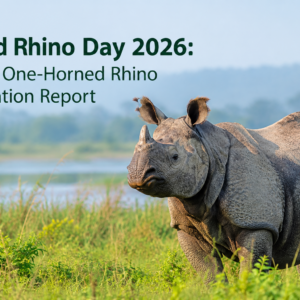

Kaziranga National Park, which supports more than 70% of the world’s one-horned rhinoceros population, may need to adopt a more scientifically rigorous approach to estimate its rhino numbers, according to experts involved in the park’s management.
Speaking to The Tribune, Rajendra G Garawad, Chief Conservator of Forests (Research, Education & Working Plan), Assam Forest Department, said the changing landscape of Kaziranga National Park makes it important to reconsider the existing “total count” method. He suggested scientifically robust sampling techniques, including distance sampling, as a possible alternative.
Garawad pointed out that the current approach assumes that every rhino within the surveyed area is detected. However, this can be difficult in Kaziranga because of its diverse terrain, which includes tall grasslands, woodlands, wetlands and riverine habitats.
Under the existing system, the park is divided into several blocks. Enumerators riding elephants cover these areas over two days and count every rhino they encounter. The observations are then combined to arrive at the official population estimate. While relatively simple to administer, the method depends on the assumption that no animals are missed.
Kaziranga covers approximately 919.48 sq km, and its landscape is constantly changing due to the Brahmaputra River. Seasonal floods can erode parts of the park, alter its terrain and influence where rhinos live and feed.
Garawad said distance sampling could offer a more practical scientific approach. Instead of requiring every animal to be spotted, researchers follow predetermined paths or transects and record the distance of each detected animal from the transect. These observations can then be used to estimate animal density across the wider landscape.
He compared the proposed shift to changes made in India’s tiger population estimation. Since 2006, the National Tiger Conservation Authority (NTCA), Wildlife Institute of India (WII) and state forest departments have used camera traps and statistically rigorous sampling techniques to estimate tiger numbers.
According to Garawad, the move towards scientific sampling improved the reliability of tiger estimates and strengthened India’s position as the country with the world’s largest tiger population.
Another forest official, who spoke anonymously, said it is impossible to detect every animal in a forest. Animals located farther from survey routes are particularly likely to go unnoticed. By analysing the distance at which animals are detected, researchers can estimate the number missed and calculate population density. The official added that the approach requires relatively basic equipment while potentially saving both time and resources.