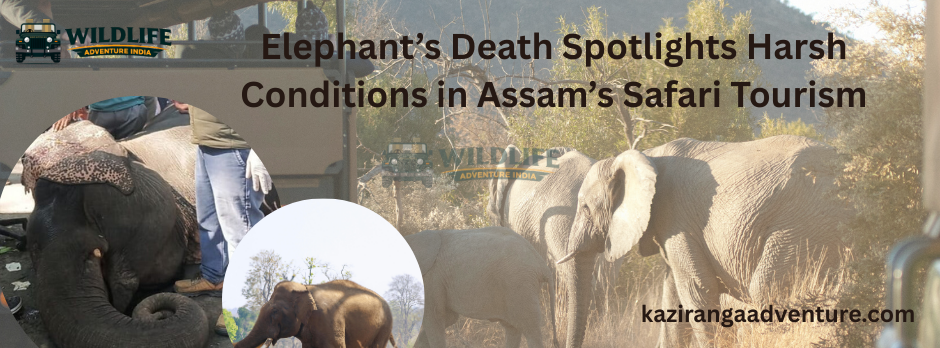
Swarnamoyee’s Death and the Hidden Cost of Safari Tourism in Kaziranga
The death of Swarnamoyee, a 50-year-old female elephant used for private safaris in Assam’s Kaziranga National Park, has sparked serious concerns about the pressures faced by safari elephants—and the fragile balance between wildlife welfare and livelihoods dependent on tourism.
Initial reports suggest that Swarnamoyee died due to respiratory failure. While her death may appear to be an isolated tragedy, it has drawn attention to deeper, systemic issues surrounding elephant safaris in one of India’s most celebrated wildlife destinations.
In Kaziranga, tourism is a crucial source of income for local communities, and elephants form the backbone of this industry. Swarnamoyee’s death has highlighted how closely human livelihoods and elephant welfare are intertwined—and how vulnerable this relationship has become.
The Day Swarnamoyee Collapsed
On the morning of December 11, 2025, Swarnamoyee had already completed two elephant safari trips carrying tourists inside Kaziranga National Park. Shortly after finishing her work, she collapsed on National Highway-715.
Veterinarians were rushed to the spot. After receiving treatment, she briefly stood up, raising hopes of recovery. But the relief was short-lived. Swarnamoyee collapsed again and did not regain consciousness.
Dr S. Borgohain, Veterinary Officer at Kaziranga National Park, who attended to her, told Mongabay-India that the preliminary diagnosis indicated respiratory failure. Postmortem examinations ruled out poisoning, and there were no signs of malnutrition. Samples of her vital organs—including the liver, lungs, spleen, and kidneys—were sent for forensic analysis.
While medical investigations continue, attention has increasingly shifted toward the broader working and living conditions of elephants used in safari tourism.
Rising Tourist Pressure and Elephant Safaris
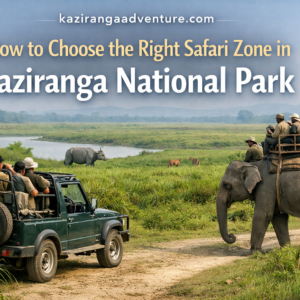
Elephant safaris are among the most popular tourist attractions in Kaziranga, particularly during the peak season from November to May. According to Bijit Dihingia, Range Officer of Bagori (Western Range), safaris operate primarily in two zones: private operators conduct safaris in Bagori, while the forest department manages them in Kohora (Central Range).
Typically, elephants undertake two safari trips each morning between 5 a.m. and 7 a.m. However, during weekends and peak tourist influx, they are often required to make a third trip. Currently, 39 elephants are used by private operators. Each elephant carries four adult tourists per ride (three in the case of smaller elephants), with each ticket priced at ₹1,350 per person.
Tourism data shows that by December 27, 2025, Kaziranga had received 146,157 visitors—134,458 domestic tourists and 6,699 foreign nationals. While these numbers underline the economic importance of tourism, they also point to increasing physical and mental stress on safari elephants.
Elephant Welfare Versus Human Livelihoods
Swarnamoyee’s death has reopened a difficult debate. On one side lies the ethical responsibility to protect elephants from overwork and stress; on the other, the survival of hundreds of families who depend on safari tourism.
Renowned conservationist and Padma Shri awardee Parbati Barua emphasised that elephants have physical and emotional limits. “Elephants should not do more than two trips a day. They are living beings, not machines,” she told Mongabay-India. She also highlighted the critical role mahouts play in ensuring the well-being of safari elephants.
Pranab Doley, an activist based in Kaziranga, acknowledged that elephant safaris generate employment for many, particularly mahouts, who may find it difficult to transition to other livelihoods. However, he stressed the need for better care standards, regular health monitoring, improved training, and government-supported facilities dedicated to elephant welfare.
The Hidden Struggles of Safari Elephants
The loss of Swarnamoyee deeply affected Pinku Ali, the tour operator who owned her and has worked in Kaziranga’s tourism sector for over two decades. He said the elephant had shown no signs of illness and suddenly began shivering and collapsing after completing her duties.
According to Dr Borgohain, even when elephants appear healthy, their living conditions can silently undermine their well-being. Many safari elephants are tethered near busy highways at night, exposed to constant noise from heavy vehicles. Disturbed sleep, combined with waking up as early as 3 a.m. in cold and foggy winter conditions, leads to chronic stress and exhaustion.
Experts warn that such long-term stress often goes undetected during routine medical examinations. Swarnamoyee had passed two health screenings—one before and one during the tourist season—conducted by veterinarians from the forest department, the Centre for Wildlife Rehabilitation and Conservation (CWRC), and the Animal Husbandry Department.
A Moment for Reflection
Swarnamoyee’s death is more than a veterinary case—it is a moment of reckoning for wildlife tourism in Kaziranga. It underscores the urgent need to reassess how safari elephants are housed, rested, monitored, and worked, especially as tourist numbers continue to rise.
Kaziranga is celebrated globally as a conservation success story. Yet true conservation must extend beyond protecting species to safeguarding the dignity, health, and well-being of individual animals. At the same time, any solution must protect the livelihoods of local communities who rely on tourism for survival.
Only by caring equally for elephants and people can Kaziranga National Park move toward a more ethical, humane, and sustainable future.